
Why Is $100 Million So Damn Hard?
Last week, I wrote about one of the great paradoxes of entrepreneurship: The very things that make you successful can eventually become the things preventing you from becoming even more successful.
When you take the leap, start your own business, and bring your dreams to fruition, you immediately set yourself apart from the masses who will never be willing to take that risk.
Your hustle, instincts, willingness to outwork everyone around you, and determination to make things happen when nobody else believes they can will take you a long way.
But can they take you to $100 million?
That’s an entirely different question.
In 2024, nearly 30 million businesses in America had no paid employees. More than 86% generated less than $100,000 a year, and roughly 99.6% generated less than $1 million.
Think about that.
For the overwhelming majority of these entrepreneurs, $1 million isn’t the starting line. It’s a finish line they will never cross.
Now start climbing.
$5 million. $10 million. $25 million. $100 million.
The air gets thinner very quickly.
So why is $100 million so damn hard?
I’ve spent a lot of time thinking about this because I’ve lived it, and I’ve come to believe one of the reasons is remarkably simple:
Entrepreneurs think getting bigger means doing more of what made them successful.
It doesn’t.
$100 million isn’t simply $10 million multiplied by ten.
Every new level requires a different organization. And perhaps more importantly…every new level requires a different you.
$0 TO $1 MILLION: PROVE IT
In the beginning, there isn’t much of an organization. You have an idea, maybe a few employees, some customers, not enough money to feed the insatiable beast, and more problems than you know what to do with.
Welcome to entrepreneurship!
At this stage, being willing to do almost anything can be your greatest competitive advantage. You sell, market, answer phones, solve problems, make decisions, put out fires, and when something needs to happen, you make it happen.
The question is simple:
Can you create something people are willing to pay for?
That’s no small accomplishment. I know—I didn’t get there in my first five business endeavors.
Building a million-dollar business requires enormous resourcefulness, resilience, and determination.
But as the company grows, something happens.
The way you’ve been operating stops working.
That’s the entrepreneur’s “come-to-Jesus” moment. We either embrace what the next level requires or allow our ego to become the ceiling on what we’ve built.
For those willing to embrace it, the game changes.
$1 MILLION TO $10 MILLION: BUILD IT
Now you have more people, customers, money, opportunities, and seemingly…a hell of a lot more problems.
Our instinct is predictable: work harder, get more involved, solve problems faster, and make more decisions.
After all, that’s what got us here.
But there’s a problem:
There’s still only one of you.
Eventually, your personal capacity becomes the organization’s capacity, and the entrepreneur who created the growth unknowingly becomes the person limiting it.
The question changes from:
Can I produce results?
to:
Can I build an organization capable of producing results beyond what I can personally produce?
That requires strengthening the four pillars every enduring organization is built upon:
Principles. People. Systems. Culture.
And perhaps hardest of all…Trust.
You have to allow other people to do things you once did yourself.
I learned this the hard way:
Most of your organization, at best, will do half of what you do well and twice as much of what you do badly.
That’s not an indictment of your people. It’s a reminder that everything you model as a leader—the good and the bad—gets amplified as the organization grows.
They’ll make mistakes you wouldn’t make.
They’ll do things differently.
And they may discover ways of doing things better than you ever did.
That’s precisely the point.
You’re no longer trying to prove that you can build something.
You’re building something capable of growing beyond you.
$10 MILLION TO $100 MILLION: SCALE IT
Now the game changes again.
More employees. Leaders. Departments. Locations. Customers. Capital. Communication. Decisions. Opportunities.
And exponentially more complexity.
Growth creates complexity.
Unless the organization’s capacity grows faster than its complexity, complexity eventually wins.
You can:
Double your company’s size without doubling its ability to lead.
Add locations faster than you develop leaders.
Hire people faster than you build culture.
Generate customers faster than your systems can serve them.
Create opportunity faster than your organization can absorb it.
Suddenly, the growth you’ve spent years fighting to create exposes every weakness in what you’ve built.
That’s the paradox of scale.
Sometimes the problem isn’t that you’ve stopped growing.
It’s that you’ve grown faster than you’ve learned to scale.
THE NEXT LEVEL REQUIRES A DIFFERENT YOU
This may be the hardest lesson of all.
At $1 million, your ability to do may be your superpower.
At $10 million, your ability to lead becomes more important.
At $100 million, your ability to build leaders who lead other leaders becomes essential.
Your role evolves from doing the work…to managing the work…to leading the people who manage the work…to creating an environment where extraordinary people produce extraordinary results without your constant involvement.
That’s not simply organizational growth.
That’s personal transformation.
Eventually, every successful entrepreneur has to confront a difficult question:
Is the version of me that built this company capable of leading the company I’m trying to build next?
Maybe. Maybe not.
Because leadership isn’t about protecting who you’ve been.
It’s about becoming who the future requires.
SO WHY IS $100 MILLION SO DAMN HARD?
Because you’re not building the same company ten times bigger.
You’re building something fundamentally different.
And you cannot build something fundamentally different while insisting on remaining fundamentally the same.
At some point, your value can no longer be measured by how many problems you solve.
It has to be measured by how many problems the organization can solve without you.
That’s when a business begins becoming an organization—and eventually, perhaps even an institution.
So if you’re serious about building toward $100 million, stop simply asking:
“How do I grow from here?”
Ask:
“What must become fundamentally different for the next version of this organization to exist?”
And perhaps more importantly:
“Who must I become to lead it?”
Until next Monday, ask yourself:
What am I still doing today because it made me successful yesterday—but may be preventing me from becoming who I need to be tomorrow?
Honor what got you here.
Then have the courage to outgrow it.
An Invitation to Build the Next Version
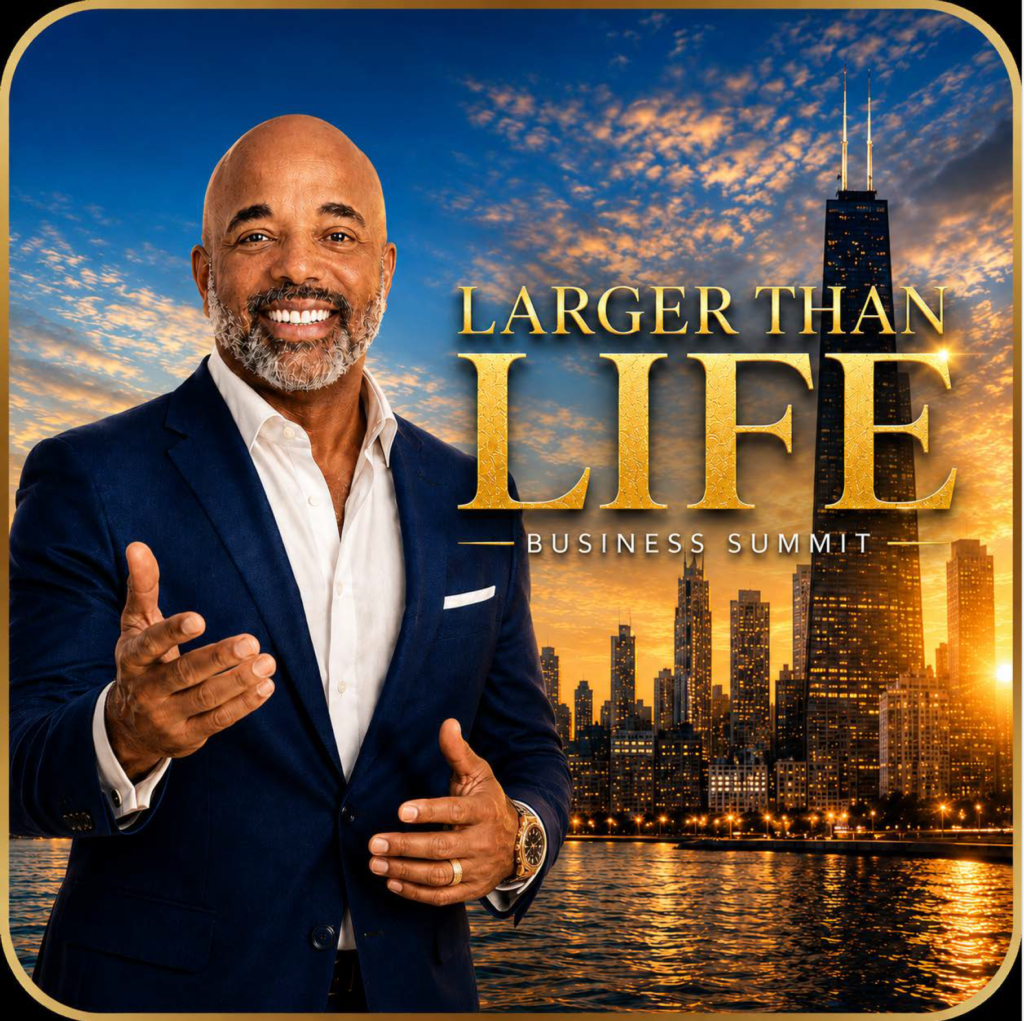
These are exactly the conversations we’ll be having on October 29, 2026, when I bring together just 30 founders in Chicago for the inaugural:
LARGER THAN LIFE BUSINESS SUMMIT
30 Founders. One Room. $100M+ Vision.
This isn’t about working harder. Successful entrepreneurs already know how to do that.
It’s about determining what must change—in your organization and in yourself—to build something that can grow exponentially.
A business makes money.
An organization runs without you.
An institution outlives you.
Which one are you building?
October 29, 2026 | Chicago | 30 Founders | Invitation Only
Be Larger Than…
One Conversation Can Change Everything.
Brett works with a limited number of entrepreneurs each month. If you’re ready to close the gap between where you are and where you’re meant to be — this is where it starts.