Stop Overthinking…Make a Damn Decision!
Today, I’m coming at you the same way I like my bourbon. Straight, with no chaser.
Napoleon Hill, author of one of the most influential personal-development books ever written, Think and Grow Rich, reportedly made a life-changing decision in just 29 seconds.
Unlike many others who chose to “think about it” and get back to Andrew Carnegie, the great steel magnate and, at the time, the wealthiest man in the world, he didn’t take 29 days… or 29 hours… he took 29 seconds… not knowing he had only 60.
According to Hill, the story goes like this.
In 1908, a young Hill was interviewing Andrew Carnegie, one of the wealthiest and most influential businessmen in the world. What began as an interview turned into a much larger conversation about success, achievement, wealth, and what separated extraordinary achievers from everyone else.
Then Carnegie presented Hill with an opportunity.
Would he dedicate the next 20 years of his life to studying some of the world’s most successful people, identifying the principles they shared, and organizing what he learned into a philosophy of achievement? Carnegie, who knew the world’s elite leaders, titans, and achievers, would personally introduce Napoleon to his circle of influence.
But there was a catch.
No salary. No guarantee of success. And potentially 20 years of Hill’s life. According to Hill’s account, Carnegie secretly started a stopwatch. He was prepared to give Hill 60 seconds to decide.
Hill said yes in 29.
His work would eventually contribute to Think and Grow Rich, one of the most influential personal-development books ever written. Historians have questioned whether every detail of the Carnegie-Hill story happened exactly as Hill described it. But there’s a lesson in the story that I believe is undeniable:
At some point, thinking has to become deciding, and once you get enough information to act, make a damn decision. Throughout my life, in the arenas where I’ve achieved top 1% performance, I’ve discovered something extraordinary: The difference between the classes and the masses often comes down to the willingness to make a decision—and act.
How much more information do you need?
Think about a decision you may be sitting on right now. Over the past three months, I’ve been sharing priceless wisdom from a front-row seat on what it takes to start a business from scratch and grow it to $100M+ in annual revenue. Though there are approximately 36 million businesses in the United States, only a tiny fraction of them reach this milestone.
If this is something you aspire to, I can offer some insights into what you may need to make that leap. For those who do, I believe one of the most important distinctions is their willingness to gather the information they need, make consequential decisions, and act.
Here’s how the masses approach decision-making: They research, ask questions, talk to people they trust, consider the upside, calculate the downside, think about what could go wrong, and then do something fascinating…they decide to think about it some more.
My question to them is this: “At what point does gathering more information stop being preparation and become procrastination?”
There’s something incredibly comfortable about remaining undecided. As long as you haven’t decided, you can’t be wrong. You risk no money, your reputation isn’t on the line, you have no expectations to live up to, and you haven’t made yourself accountable for producing a result.
The challenge is that this insidious indecision allows us to preserve the possibility of success without accepting the responsibility to pursue it.
That’s why overthinking can be one of the most sophisticated forms of procrastination. Successful people don’t call it procrastination, of course. We call it: due diligence, strategic planning, evaluating our options, waiting for the right time, etc.. Sometimes that’s exactly what we’re doing and sometimes…we’re using our intelligence to rationalize our inaction.
The 1% Don’t Wait for Certainty.
To be clear, I’m not suggesting you make reckless decisions. But do recognize the difference between being informed and being certain. Being informed means you have enough relevant information to make a reasoned decision. Being certain means you’re waiting for the possibility of being wrong to disappear.
Good luck with that.
Those operating at the highest levels don’t have a crystal ball. We do exactly what Napoleon Hill did: once we have enough information, we make a damn decision. Sometimes, you can only get the information you’re waiting for after you move.
And Then There’s the $1,997 Question…
As I’ve invited entrepreneurs to the LARGER THAN LIFE Business Summit, I recognize there are some who would love to come but look at the investment as an obstacle and don’t believe they can afford it. I get it…big time. I’ve been broke, busted, and disgusted, and I’ve faced financial challenges throughout my entrepreneurial career. In fact, I’ve been out of a steady paycheck for over a year now and have invested heavily in my new business, Be Larger Than, LLC.
I would never suggest that someone neglect their financial responsibilities to attend a seminar. But if you’re a business owner, I want you to examine the thinking behind the belief that you can’t afford it.
There’s a difference between not having $1,997 and believing you cannot afford to invest $1,997 in becoming more capable of building the business you say you want. One is a financial reality. The other may be the very thinking keeping you where you are.
If you’re running a business and your current circumstances make a $1,997 investment in your own growth seem impossible, I would ask a different question: Can you afford to keep thinking the way you’re thinking?
Albert Einstein recognized that new challenges demand new ways of thinking. The principle applies equally to entrepreneurship: You can’t expect fundamentally different results while remaining committed to the same assumptions, beliefs, and behaviors that produced your current circumstances.
If you’re struggling financially, simply protecting every dollar may not be enough. The real opportunity may lie in becoming better at creating income. And if your business isn’t growing, repeating the same approach is unlikely to change the outcome. Growth may depend on learning to think and operate differently.
And if you aspire to operate among the top 1%, at some point you have to stop letting today’s circumstances dictate what you’re willing to invest in tomorrow’s possibilities. You won’t always be right. Not every investment is a good one, not every seminar is worth attending, and spending money doesn’t automatically equal success…but neither does refusing to invest in yourself because your current thinking tells you that you can’t.
Sometimes the greatest risk isn’t losing $1,997; it’s spending another year operating with the same thinking that made $1,997 feel impossible in the first place. In my past, I know I’ve spent enormous amounts of time calculating the cost of making the wrong decision while never calculating the cost of making no decision…so make one!
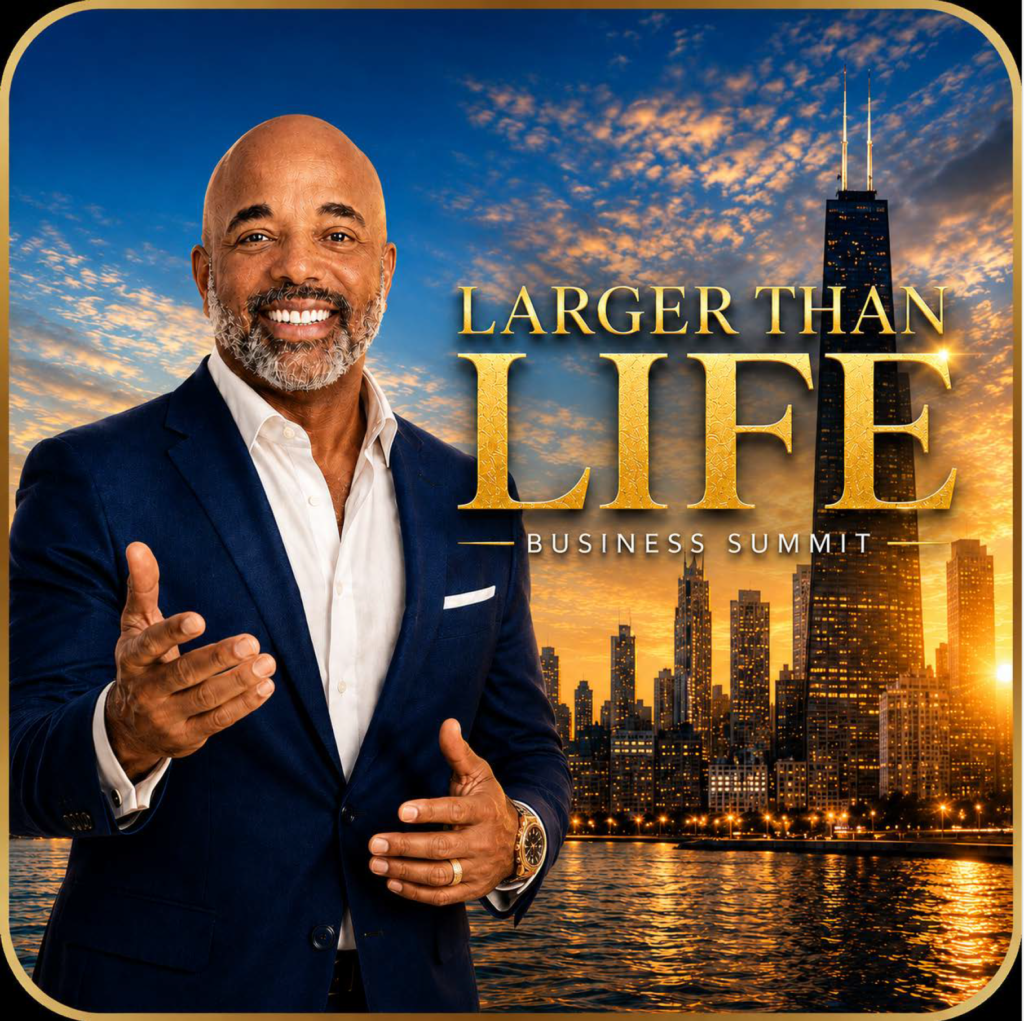
On October 29, I’m bringing 30 founders together in Chicago for the LARGER THAN LIFE Business Summit. The investment is $1,997. It’s designed for founders of businesses generating $1 million or more who know they’re capable of building something much larger.
I’m not going to spend the end of this article trying to convince you to attend. If you’ve been following this series, you know what I’m building, who it’s for, the investment, and the date. If you’ve been considering attending, I have one question: “What information are you still missing?”
Napoleon Hill reportedly had 60 seconds...he needed 29.
The Summit is now less than three weeks away. If you already know you belong in that room, what the hell are you waiting for? Your future doesn’t begin when you finally feel ready. It begins when you decide to move.
Results rather than reasons…
LARGER THAN LIFE Business Summit
October 29, 2026 | Chicago
30 Founders. One Room. One $100M+ Standard.
Make a damn decision.
One Conversation Can Change Everything.
Brett works with a limited number of entrepreneurs each month. If you’re ready to close the gap between where you are and where you’re meant to be — this is where it starts.