
Every New Level Requires a New You
Most entrepreneurs make one mistake before they ever hire their first employee. They treat their business like a child they’ll raise forever, rather than an organization they’ll eventually release. That’s how founders unknowingly build prisons instead of businesses.
Last week, we discussed one of the leading causes of founder burnout: organizational dependency. When everything depends on you, you eventually become the bottleneck. As entrepreneurs, we often believe the solution is to work harder. It isn’t. We must build systems and leaders that enable the business to grow beyond us.
This is an important distinction that most founders never truly consider. When venturing out to start your own business, since it’s your baby, unlike an actual child, you don’t think of it growing up and wanting to spread its wings on its own.
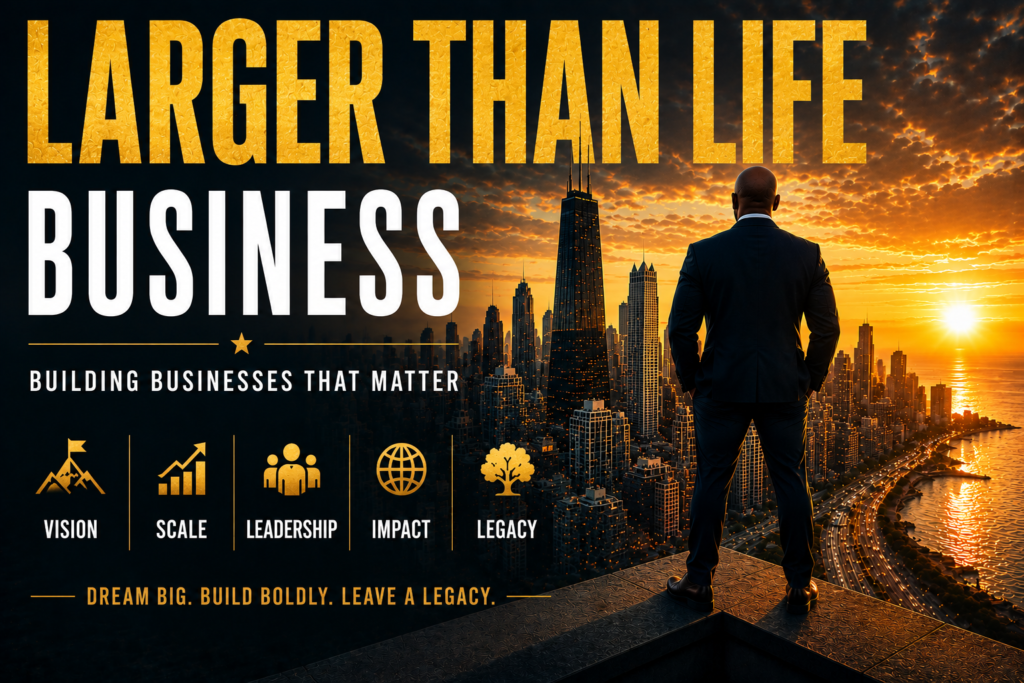
Most entrepreneurs tie their identity to their business and don’t consider the day when it will operate without them. This is how you build a prison… NOT a LARGER THAN LIFE Business that will not only survive but also thrive beyond your lifetime, serving generations into the future. I share this as someone who knows this perspective intimately, because that was me.
This week, I’d like to introduce what I believe is one of the most important distinctions I’ve learned as an entrepreneur. Every new level of business requires a new version of you.
Most entrepreneurs believe that bigger businesses require better strategies, initiatives, market conditions, or capital investment. They don’t.
Bigger businesses require bigger leaders. In John Maxwell’s seminal book, The 21 Irrefutable Laws of Leadership, Law #1 is “The Law of the Lid.” It states that your effectiveness is capped by your leadership ability. This is because anything you do that involves people requires leadership, and building a business involves people… a lot of them.
Think about it for a moment. The person capable of building a $500,000 business is not the same as the person who can successfully lead a $10 million company. Likewise, the entrepreneur who grows a $10 million enterprise will almost certainly need to become someone different to build a $100 million organization.
The business doesn’t simply grow. The founder must grow first. That’s why your company will never consistently outperform your identity. One of the greatest misconceptions in entrepreneurship is believing the next breakthrough is “out there” somewhere—a better marketing strategy, another salesperson, a guru with the answers, a better CRM, or the latest AI tool.
Those things matter and can have a significant, measurable impact, but they are almost never the constraint. You are.
The good news is that you’re also the opportunity. As I reflect on my own entrepreneurial journey, I can clearly see several different versions of Brett.
The young entrepreneur who started his first business believed hard work solved everything. I thought that if I simply worked longer hours than everyone else, success was inevitable. It worked for me as an elite athlete, placing me in the top 1% of my sport. Why wouldn’t it work the same way for something I thought I could control, like my own business?
Then came five failed businesses over twelve years.
Those failures didn’t just teach me better business principles. They forced me to become a different man. They challenged my thinking, exposed my weaknesses, humbled my ego, and developed resilience that no seminar or book could ever have taught me.
By the time my partners and I built our sixth business, I had become a different leader. As our organization grew from a handful of people to dozens, then hundreds, and eventually thousands, I discovered another truth.
The leadership style that gets you here won’t get you there. At first, I needed to be the producer, then the manager, and soon I became the leader. To build a $100M+ business, I had to become the developer of leaders. Ultimately, I had to become the architect of an organization capable of thriving without my daily involvement.
Each transition required letting go of the previous version of myself. Looking back, every major growth plateau at our company had very little to do with market conditions or competition. It almost always reflected a leadership ceiling. Mine.
John Maxwell has often said that everything rises and falls on leadership. I would simply add this: Everything rises and falls on the founder’s leadership capacity. That’s why I believe entrepreneurship is the greatest personal development program ever created.
Business has an incredible way of exposing every insecurity, weakness, fear, blind spot, and limitation we have. It reveals where we avoid difficult conversations. It uncovers where we lack discipline. It forces us to confront our ego, patience, emotional maturity, and ability to trust others.
The larger the business grows, the less your success depends on what you know and the more it depends on who you’ve become. So let me leave you with a question that has shaped much of my own thinking.
Instead of asking, “What do I need to do to build a $100 million company?”
Ask yourself, “Who must I become before my business can become what I say I want it to become?”
One question focuses on activity. The other focuses on identity. One changes your schedule. The other changes your future.
Every new level of business demands a new level of leadership. Every new level of leadership demands a new version of you.
Become that person…and your business will eventually catch up.
Be Larger Than…
One Conversation Can Change Everything.
Brett works with a limited number of entrepreneurs each month. If you’re ready to close the gap between where you are and where you’re meant to be — this is where it starts.